FEATURED NATURALIST INTERVIEW
Updated: Jun 17
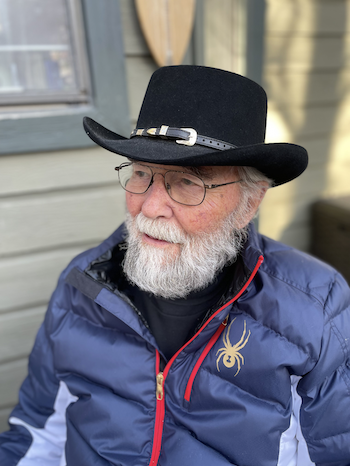
Val Grant

Q: What is a naturalist?
"A naturalist, to me, is someone who is dedicated to what happens around them; they are dedicated to the environment that they live in. There are so many small things that are part of everything around you and everything that you do. It’s one thing to be able to see those details, to feel them, to hear them, and touch them, but it’s another thing entirely to take all that information, translate it, and transfer it to somebody else who now understands it as well. That's what I look at as a naturalist."
Q: Do you have a time, moment or place that was pivotal to your relation to nature?
"The time that it became abundantly clear that I didn't know [ … ] anything was when I took a job with the Fish and Wildlife Service back in 1964. I was working in animal damage control. My boss was a Ph.D. who came to Denver to work at the Fish and Wildlife. I went to work for him and he allowed me a lot of room to help design studies. We needed to learn how to operate with precise descriptions and then generate statistics. We focused on precision. He and a couple of other guys in Denver were probably the biggest influence on how I looked at nature to determine what was actually happening.
That went even further when I came out here (USU) and started working with Dr. Muller Schwarze. I was doing pheromone work on Coyotes, trying to use scent to lure Coyotes in so that you could kill them. I thought, “Well, we'll see what we can do.” My focus, though, was to repel animals rather than kill them--and to convince my co-workers that killing them was not a good thing to do.
Unfortunately, Schwatze only lasted a quarter. He wasn't granted Associate Professor status, so he left and actually had a successful career at the University of Syracuse.

Dave Balph became my mentor. Dave was a fine teacher. He walked up to me one day and said, “You probably feel terrible now that your Ph.D. program is probably down the tubes. What were you working on before?" I said “Starlings.” “Doing what?” I was trying to find a repellent that might work for Starlings. I was doing research on Starlings and Redwing Blackbirds and the objective of the research was to kill the animal. That was the way to protect the resource they were eating: to kill the creature that was eating it. I thought, “Well there are different ways to do that and keep the animal alive.” At least I thought there were. So he (Dave Balph) said, “Write up a study and give me your whole study plan, how you want to do this and I'll finance you all the way through. ”Whoa!” Well that set me off on a look at animals and a look at Starlings in particular. That was just the best damn thing that I have ever done. To see as close as I could the behavior of Starlings and then to look as closely at the behavior of other animals, humans included. I thought “Wow!, this is exciting.” It was where I wanted to be.
Well I finished the thing up and when we looked at the possibility of changing their behavior, of repelling them from feeding, we found out that there was one chemical that would make the Starling become very ill. Illness didn't happen until two to five minutes after they ate. The chemical had to get into their blood and circulate into the lower brain; this then kicked off the vagus nerve and caused them to vomit. We speak of the five senses but we need to add the vagus to that. Whatever it hit caused them to want to get that food out just as fast as possible. It wouldn't kill them but it would make them sick to the point of unconsciousness. Once they woke up they remembered that their dreadful experience had something to do with the food they had just eaten. After that they wouldn't touch it. I thought, "This is great!” We learned it worked like a charm with small populations. If 15,000 to 500,000 Starlings are feeding in a feedlot, there is not a […] thing you can do about it. They can have Starlings all around them throwing up their insides, but it will not stop them from feeding.”
Now it was different with the Redwing Blackbird. This same chemical would cause a Redwing Blackbird, if they were feeding in a flock, to spiral into the air giving an ungodly call. The other birds would go berserk and then they were out of there. All it took was one bird giving that call, screaming like a banshee, and the entire flock took off.
Everyone was just stunned that it worked that well. What I was looking at was if somebody were trying to protect a Holly orchard or some other small crop, but the Starlings were attacking. This chemical worked like a charm. That was encouraging. There was never a call to eliminate the Red Wings. Their instinct to make that blood-curdling cry meant there was no need to wipe out an entire population.
From there I fell into a job with Dave (Balph) monitoring bats, birds, reptiles and amphibians on energy development tracts. Mostly oil shale. That was another job that just flabbergasted me. We did walk transects to count animals in the morning, mid-morning and evening. We also set traps for rodents and watched what was happening with different populations. I was so excited about this kind of work that when I retired I spent three years believing that I just had to get back to it. A friend said to me, “Val, you are retired.” It took a minute, but I finally replied, “Retired? Oh yes, I am retired!”"
Q: What are three things most human beings need to know about the world?
"Well, I know one thing for sure would be that every child should be introduced to some species the moment it is born. The species could be any class, vertebrate or invertebrate. The human would gain knowledge of that species from the time they were babies all the way until the day they die. Each person would then have a deep connection with another living being. The person would be exposed to everything about that species, and in the learning process, the child (and later the adult) would also gain more understanding about humans. It's a back and forth kind of thing. It is absolutely wonderful. The Starlings were one of my biggest teachers. So that would be one thing. Every child, male or female, would have that knowledge. That one thing would give us a chance to save the biological world. Why? Because when you are among other living things, you begin to identify with those other things and, suddenly it just opens up the world for you. That is an aspect that I absolutely love.
Let’s say that somebody comes along and they want to get rid of some invertebrate, maybe some beetle. But a kid has been following that beetle through its lifespan. When the person comes along and wants to kill that beetle, the kid says, “Wait a minute! I know a lot about this beetle. You can't just wipe it out.” “Oh yes we can!” “No you can't!” So all of a sudden, we have a point of disparity where one side thinks it’s a good thing and another side thinks no, this is not a good thing. That means you have to come to some outcome in the middle. The verdict will likely be that you spare the life of that creature and you also learn how to save the crop or whatever it is you want to protect. You give the animal a chance to teach you what you need to know. Its needs, its responses, its life become part of your knowledge and your understanding helps others make better decisions. Other creatures adapt in this way. That’s what it’s all about. Taking this into the invertebrate world is kind of tough because there we’re no longer working with animals with a central neural system but I think the idea still applies.
Well people are going to hate this next idea, my number two point about what human beings need to know about the world. Number 2: Get a Jesuit education. When I got out of parochial school back in Denver, I went to Regis High School, and then o Regis College. They were both Jesuit schools. I came out of grade school and was described as a boy who liked to be silly. That was a detriment. It wasn't treasured. But I had teachers with a strong hold on reality and their ability to deal with students was spectacular. I've had people ask me, "Where did you go to college?" “Regis College.” They replied, “Well that is a Jesuit school.” I answered,, “Well no damned wonder. That is probably one of the best educations that you can get.” So that is my Number Two."
Q: What are the greatest gifts that we bring to the planet? What can we give that might adorn the place rather than the path of devastation and plunder that we are now on?
"Well I think the idea of identifying with a species brings you into a whole different world where you have to take other living things into consideration. It takes away the idea, like our current Department of War suggests, that to kill something is the best that you can do. How could you ever come to that conclusion! That response is eliminated. As you look at some species you get to know them. It takes you into a world beyond and larger than yourself. They (other species) then open a world to you that you never knew existed. That can change your mind real quick."
Q: What are the foundational skills needed to be a naturalist?
"The study of biology is foundational. However, that doesn't mean you need to find it in a
formal education. It is something that you can pick up on your own. Perhaps you see some plants and you follow those plants as they change; you see what happens over months, over years, over decades. That is the kind of thing that you need. And you need to follow. You have to have something there that you can follow and use that as a guiding light. I've had people work for me that had no biological education, yet were very good biologists. They took to field work as if it was where they should have been. I had one guy, Ralph Miller. He was from Chicago. I got him in the field and he was just absolutely spectacular. Another was Nolan Preece, a photographer. I needed workers who could pick out the species differences between birds and reptiles. Here was this guy who never had any formal training in biology. But he did have formal training in photography. He was able to notice small items of detail and fit it all together. He was a great field biologist. You run into that and think, “Hey these guys could take over the world and run it well.”"
Q: Are there any moral or ethical obligations to being a naturalist?
"Hello?" (Laughter)
Q: Are naturalists important to this modern, predominantly urban world?
"As you follow the history of biology, the people who introduced us into looking at the biological world were the naturalists. They studied grasses, well they studied species. This is what they did. They speak of the "scientific method". The scientific method, if you are looking for completion within yourself, is a dead end. To depend upon statistical evaluations and evidence can lead you into making some really good decisions, but, at the same time it is not something that you want to base your life on. You have to look at the aspects of compassion, the aspects of emotion that come into play. I think that this is something that we lack. We should teach emotion. That has to be a part of what you do. You can't just say, “Well, that is a number and that's what you are and that's the way it is going to be.” No. You need to look for change. That needs to be part of our observation. Change is always very difficult to study. I've known a lot of scientists who have said, “Val, you can't say that. That is outside the rules of biology.” “No it's not!” “Yes it is!” Happiness is part of it too. I have been a very happy individual. So far; although this […] Covid is proving a challenge. I cannot imagine having an attitude that is not about giving and taking. That is all part of what makes life a lot of fun. If you want something, you have to give something."
Q: What one word would, an ephemeral tag, that you would be most comfortable being known for?
"Friend. I would make that become the objective of life. (Friend comes from the Latin word: "Amare": To love)"
Val Grant is a graduate of Regis College with a Bachelor of Science in Zoology in 1964. He continued his education at the University of Colorado in Denver while employed by U. S. Fish and Wildlife Service working in Animal Damage Control for the Bird Control Program until 1970. He, his wife Sue and their three children moved to Logan, Utah where he began his work for his PhD program, Behavioral Control of Starlings. He completed his study in 1978 during which he formed Bio-Resources, Inc. surveying the wildlife and vegetation on mining and energy properties in the Western United States and Mexico. He retired in 2010.
Comments