Coyotes and Owls
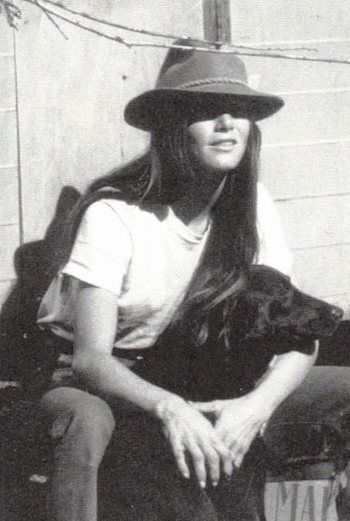
An excerpt from Herding Sheep in Northern Utah (1998; pp. 80-82)
By Laurie Rich

The Coyotes and the Owls had a wholly unique dialogue with each other that would expand to me in their discourse. They both hunted at night and shared common hunting routes, and I began to be party to their network of communication when I would appear each spring with my yearlings. As the coyotes began teaching their pups to kill each summer and fall, my yearlings were their bullseye. The Owls were my late-night dragnet. They would beam in on the coyotes’ line of travel, and signal to each other the ongoing drama. One night in late July, they carried on a dialogue the whole night long. Coyote howls followed by Owls hooting an answer, again and again repeating their relay that started at the top of Cinnamon Creek, reached a forte mid-canyon around the beaver ponds, and carried on down the length of the canyon to where my sheepcamp was overlooking the confluence and my sheep were bedded down on the ridge above.
I had the uncanny suspicion, now blatantly obvious, that this all-night dialogue of hoots and howls was culminating in the vicinity of my herd. In the gray predawn, I was all saddled-up, had the coffee on, was just about to head up the ridge when I looked out the sheepcamp window and saw this huge Great Horned Owl as big as myself, lighted in the aspen tree there, and staring right at me with giant gold onyx eyes. With studied expectation, he hooted loudly at me as if awaiting my response. I had somehow been included in the ongoing dialogue I had witnessed all night. And when I galloped up to my herd that morning there had just been born a new little lamb, and safe, as the coyotes howled from their thwarted position, circling in the canyon below. A very late lamb born off-season from a “dry” yearling ewe that somehow the bucks got to, born in the wrong place at the wrong time, protected by the Owls, the herder, and a few old biddies in the herd who surrounded the lamb with mothering as the yearlings pranced off to feed in the lush north woods of Mineral Point.
Even though yearlings are a prime target of coyotes compared to the tough old ewes, I lost very few sheep to coyotes those 4 years I herded on state lease. The sheepherder’s best defense is the fact that coyotes hate Man. You would too if he went around in a helicopter gunning down hundreds of your loved ones from the air in the winter and methodically trying to kill you in every way imaginable. Coyotes felt a deep love for their fellows, and mourn for many hours over the loss of a loved one, howling deep into the night, and building a sense of revenge. Good predator control is the art of keeping that sense of revenge from triggering a backlash. Killing more only causes more killing. Something the human race could stand to learn.
My key defenses were my mere mortal presence, the unpredictability of my noise, banging pots and pans in the middle of the night, the smoke from my wood stove, my urine placed strategically around the bedground, my BO (sheepherders do smell!!), my human presence felt and hated, and keeping a close watch on my herd. My boss had no guard dogs or llamas back then. The trapper would often stop by on his rounds of the camps to ask if I had any coyote troubles and find out what they were. If they were attacking my sheep, he might set a trapline or go out with his gun and call them to him with his wounded rabbit call. If the coyotes weren’t bothering my sheep, he might just leave them alone to hold their niche in the territory against invasion by a more aggressive band of coyotes.
The trapper and I shared a deep reverence and respect for the coyotes, for their superior wit and intelligence. We also shared a common opinion that coyotes were smarter than any humans we’d ever known. His long experience matching wits with coyotes as a predator control ranger was expressed in fascinated hushed tones as he told his surprising stories in that sing-song Duchesne accent. He told me about one band up on Monte Cristo that could smell steel. Every time he buried a steel trapline, combed over and camouflaged expertly with brush and twigs and baited with his special formula of female coyote heat scent, they would follow along the trapline, methodically springing every trap along his line without getting caught. Stealthy tracksters. I always figured they could probably smell my gun, since the only time I’d see them was when I had no rifle on the saddle. But then, at least I knew where they were, and that was a key defense, too.

Author Bio:
Laurie Rich was a Utah sheepherder for 10 years, herding 4 years on 10 sections of state lease land on Cinnamon Creek and Scare Canyon below Monte Cristo, then on Mount Nebo - Devil’s Kitchen, Pole Canyon, Hop Creek Ridge, Spencer Fork - then on the Manti-La-Sal - North San Pitch above Fairview. Later, with a degree in Microbiology from Weber State, she did research for 10 years - at U. of U. Hospital Infectious Diseases on toxins of pseudomonas and chlamydia, at state health for the EPA on methods of testing for Giardia and Cryptosporidium in drinking water, and in pharmaceuticals at Research Park. She is the author of 2 books: Apologia for Vietnam, 1995, and Herding Sheep in Northern Utah, 1998.


Comments